

Creatinine and eGFR Explained: Understanding Your Kidney Test
Posted 01 Jul 2026 | Source:
If you have had a blood test that mentioned your kidneys, you have almost certainly come across two numbers: creatinine and eGFR. These are the most widely used measures of kidney function, and understanding what they mean can help you make sense of your own health. This article explains both in plain language.
What is creatinine?
Creatinine is a waste product. It is produced continuously by your muscles as a by-product of normal activity, and it travels in the blood to the kidneys, which filter it out and remove it in the urine. Because the kidneys are responsible for clearing creatinine, the level of creatinine in your blood acts as an indirect measure of how well your kidneys are working.
When the kidneys are filtering well, creatinine is cleared efficiently and its level in the blood stays low. When kidney function declines, creatinine is cleared less effectively, and its level in the blood rises. In simple terms: a higher creatinine generally means reduced kidney function.
Why creatinine alone can be misleading ?
Here is an important subtlety. Creatinine comes from muscle, so the amount a person produces depends on their muscle mass. A muscular young man naturally produces more creatinine than a slim elderly woman, even if their kidneys are working identically. This means the same creatinine value can represent very different levels of kidney function in different people.
For this reason, creatinine on its own can be misleading. A “normal-looking” creatinine in a person with low muscle mass — for example, an elderly or frail individual — may actually conceal significant kidney impairment. This is one reason doctors do not rely on creatinine alone.
What is eGFR?
This is where eGFR comes in. eGFR stands for estimated glomerular filtration rate. It is a calculation that takes your creatinine level and adjusts it for factors such as age and sex, producing a single number that estimates how well your kidneys are filtering. It is expressed in millilitres per minute per 1.73 square metres of body surface area, though most people simply refer to the number itself.
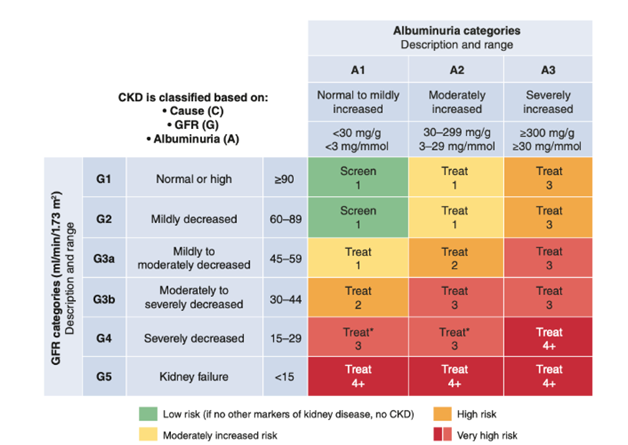
The eGFR is more useful than creatinine alone because it accounts for some of the factors that affect creatinine production. A normal eGFR is generally around 90 or above. As kidney function declines, the eGFR falls. The five stages of chronic kidney disease are defined largely by eGFR, ranging from near-normal function in the early stages to severely reduced function — below 15 — in established kidney failure.
What your eGFR means in practice ?
A single eGFR result should be interpreted with some caution. It is an estimate, not a perfect measurement, and it can be affected by temporary factors such as dehydration, recent heavy exercise, a high-protein meal, or certain medications. A single slightly low reading does not necessarily mean you have kidney disease.
What matters more is the trend over time. A stable eGFR, even if mildly reduced, is far more reassuring than one that is steadily falling. This is why doctors often repeat the test and look at the pattern across several months rather than reacting to one result.
It is also worth knowing that eGFR naturally declines slowly with age, even in healthy people. A modest reduction in an older person may simply reflect normal ageing rather than disease, which is why the number is always interpreted alongside other information, particularly the urine albumin test.
Creatinine, eGFR, and the urine test together
The fullest picture of kidney health comes from combining the eGFR with a urine test for albumin (the UACR). The eGFR tells us how well the kidneys are filtering; the urine albumin tells us whether the filters are damaged and leaking. A person can have a normal eGFR but still have kidney damage detectable only through the urine test, which is why both are recommended, especially for people with diabetes or high blood pressure.
A note on accuracy and interpretation
I should be honest that these are estimates and screening tools, not absolute verdicts. The numbers must always be interpreted by a doctor in the context of your overall health, your other test results, and the trend over time. If your eGFR is reduced or your creatinine is raised, the right next step is a conversation with a doctor rather than alarm — many explanations are benign, and where there is a genuine problem, finding it early is an advantage.
If your creatinine or eGFR results are outside the normal range, a nephrologist can help you understand what they mean for you specifically and what, if anything, needs to be done.
